
Why Choose Flexo Printing for Exercise Book Production?
How flexo printing works, how it compares with offset, and when a standalone print-and-cut line fits your production needs.
How can you lower the production cost per exercise book, print inner pages more efficiently and reduce paper handling and manual work? For manufacturers planning a continuous route from paper reels to finished books, the inner-page printing stage has a direct effect on the capacity of the whole production process.
Exercise book and notebook inner pages typically contain lines, grids and basic text. Printing priorities often center on keeping these patterns uniform at high speed, with less emphasis on photographic detail and complex color reproduction. These requirements make flexo printing for exercise book production a practical option. Continuous reel feeding can reduce intermediate handling and connect printing with downstream operations.
1. Why manufacturers use flexo printing for exercise book production
Many exercise book inner-page designs use one or two colors and repeat the same layout across thousands of sheets. Typical artwork includes blue or gray ruled lines, red margin lines, square grids for mathematics, and small headings, page numbers or table rules.
A web-fed flexo press reproduces these patterns with a flexible printing plate mounted on a rotating cylinder. As the paper moves through the press, the layout repeats continuously along the web. This arrangement suits long runs of ruled stationery, especially when the same designs return in later orders.
For these jobs, the combination of repeatable ruling and continuous paper flow is particularly valuable. Depending on the line configuration, printing can connect with cutting, counting and folding. Matching these stages can reduce the need to stack, move and reload paper between operations.


2. How does a flexo printing machine work?
A web-fed flexo printing machine combines paper transport with controlled ink transfer. The main units each have a specific role in keeping the printed pattern consistent as the paper moves through the press.
- Unwinding unit. Feeds paper from a reel into the machine.
- Web tension control. Regulates tension as the paper travels through the printing units.
- Ink supply system. Supplies ink to the metering system.
- Anilox roller. Uses engraved cells to meter ink onto the raised areas of the printing plate.
- Plate cylinder. Carries the flexible plate and repeats the artwork as it rotates.
- Impression cylinder. Supports the paper against the plate during image transfer.
- Rewinding or sheeting unit. Collects the printed web as a roll or cuts it into sheets, depending on the machine configuration.

Ink passes from the supply system to the anilox roller, then to the raised image on the flexible plate. The plate transfers the pattern directly onto the paper, which is supported by the impression cylinder. Metered ink delivery helps keep ruled lines clear and uniform throughout the run.
Stable web tension and print registration are equally important. A page with blue horizontal lines and a red margin needs the two colors to stay aligned. Double-sided work also requires consistent front-to-back alignment, and the ruling must sit correctly on the sheet after cutting. Plate positioning, paper transport and print-to-cut coordination all contribute to the result.
For water-based inks, operators should keep viscosity and pH within the ink supplier’s recommended ranges. Suitable ink delivery, printing pressure and drying conditions help maintain the approved line quality at the intended production speed.
3. Flexo vs. offset printing for exercise book production
Both processes can produce stationery. The choice depends on the artwork, order pattern and how printing fits the rest of the factory. The comparison below focuses on web-fed flexo ruling equipment and sheet-fed offset presses commonly considered for notebook work.
| Factor | Web-fed flexo | Sheet-fed offset |
|---|---|---|
| Artwork complexity | A practical fit for repeated lines, grids and simple one- or two-color inner-page layouts. | Well suited to fine image detail, photographs and multicolor artwork, including illustrated covers. |
| Order quantity and repetition | Continuous web transport supports long runs. Plates in good condition can serve recurring designs. | Can serve varied cover and inner-page jobs. Run economics depend on quantity, press format and setup requirements. |
| Plates and plate-making cost | Flexible plates can be reused for unchanged designs. Initial cost and useful life depend on plate type, size and care. | Cost depends on plate size, color count and the number of plates required. Obtain costs for the actual job. |
| Changeovers and setup | May involve plate mounting, ink changes, registration and web adjustments. Grouping similar jobs can reduce setup work. | May involve plate changes, ink and water balance, registration and feeder settings. Automation and job similarity affect setup time. |
| Paper feeding | Paper unwinds continuously from a reel and can be delivered as printed sheets or rewound, according to configuration. | Feeds individual sheets. Sheet size and handling must match subsequent operations. |
| Downstream integration | Can combine printing with cutting and sheet delivery, with counting or folding where specified. | Printed sheets can feed automated finishing equipment. Direct inline connections depend on the press and finishing configuration. |
A major advantage of roll-fed flexographic printing is its potential to integrate with downstream production processes. For exercise book manufacturers, moving paper through printing and converting in a coordinated sequence can reduce handling and help balance production capacity.
Offset remains a suitable option for detailed cover artwork or image-rich inner pages. A manufacturer may use offset for illustrated covers and flexo for ruled inner sheets. Compare total job costs, including plates, setup labor, paper waste, ink and the handling needed before binding.
4. From roll paper to printed sheets
A print-and-cut line gives flexo printing for exercise book production a straightforward material path. Paper enters as a reel and leaves as printed sheets prepared for the next operation.
Basic material flow through a web-fed flexo printing and cutting line.
- Roll unwinding. Paper feeds from the reel with tension and guiding controlled for stable transport.
- Flexographic printing. The printing units apply the required ruling. The color arrangement and printing on each side follow the job specification.
- Cutting. The printed web is cut to the planned sheet format, keeping the ruling aligned with the cut edges.
- Sheet delivery. Printed sheets are collected for subsequent folding and binding operations.
Heli Machinery’s HL-1100RY web-fed flexo printing and cutting line combines unwinding, two-color printing on both sides, cutting and sheet collection. It uses water-based inks and offers an optional downstream folding unit. This configuration supplies printed sheets for the selected exercise book or notebook-making process. For a roll-to-finished-book workflow, compare Heli’s exercise book production line solutions.
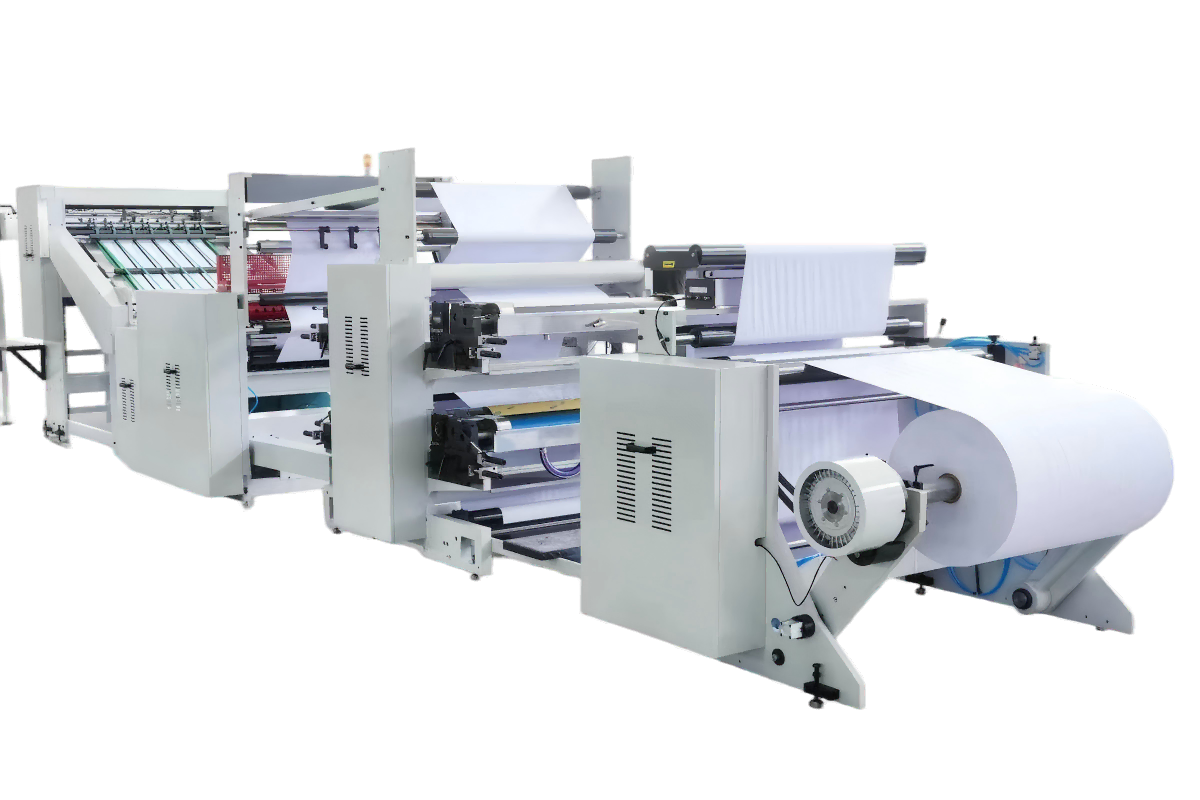
To extend the process through to finished exercise books, the folding, cover feeding, binding and trimming stages must be configured for the product. Check sheet format, page count, material transfer and working speed across the planned equipment. Sustainable output depends on paper behavior, ink drying and the capacity of each connected stage.
5. When does a standalone flexo printing machine make sense?
A standalone flexo printing and cutting line can prepare inner sheets for separate finishing equipment. It is worth considering in the following production situations.
Starting production with a limited budget
A new business may begin with a dedicated print-and-cut line and separate finishing machines, then add capacity as orders grow. Assess the complete investment, including plate preparation, paper handling, labor and binding equipment, against expected sales and cash flow.
Making several notebook types in smaller batches
A factory producing saddle-stitched, thread-sewn and cold-glue spine-bound notebooks may share inner-page printing capacity across several finishing routes. A standalone line can supply these routes when its sheet sizes and printed layouts match their requirements. For small batches, include changeover time and startup waste when assessing whether flexo fits the order mix.
Adding printing capacity to an existing factory
If finishing machines regularly wait for printed inner sheets, an additional flexo line may help increase supply. Review actual output and waiting time first, then match the proposed printing and cutting capacity with the available folding and binding capacity.
For each situation, give the supplier your artwork, paper weight, reel width, finished book size, page count, binding methods and typical batch quantities. A trial with representative paper and artwork can show ruling quality, print-to-cut alignment, setup waste and how the sheets feed into the next operation.