
Exercise Book Making Machine: A Step-by-Step Selection Framework
Six decisions that determine whether your exercise book production line is a profit centre or a capital trap — and how to get each one right.
Choosing the wrong para la fabricación de cuadernos de ejercicios can cost a converter thousands in wasted paper, lost tenders and months of downtime. With prices ranging from under USD 15,000 for a basic reel-to-bunch unit to over USD 150,000 for a fully automatic, servo-driven line, the question “How much does one cost?” is unanswerable without first defining your production reality. A machine that is the right choice at USD 40,000 for one converter may be a costly mistake at USD 80,000 for another.
This guide reframes para la fabricación de cuadernos de ejercicios selection as six interconnected decisions. Work through them in order and you arrive at a configured quotation that matches your production reality. The perspective is grounded in over two decades of manufacturing and exporting web-fed flexo ruling, saddle stitching and perfect binding production lines at Lanxi Heli Printing Machinery Co., Ltd., with lines running in 15+ countries including Indonesia, Vietnam, Colombia, Mexico and Angola.[1]
1 Define Your Production Profile
Before comparing machines, quantify the production reality the line must serve. Four variables determine every downstream configuration choice:
Target product specifications
- Page count range — 20, 40, 60, 80, 120 pages? This drives binding method selection (saddle stitching struggles above 64 pages).
- Format — A4, A5, B5, or a custom school format? Some markets (West Africa, South Asia) use non-ISO formats that require specific web widths.
- Ruling pattern — single-colour (blue lines) or dual-colour (blue + red margin)? Each additional element may require an extra flexo station.
- Cover type — self-cover (same stock, folded from the web) or separate pre-printed cover? Separate covers require a cover-feeding module.
Volume requirements
Calculate demand in books per month, not per year — monthly figures expose seasonality. Most government tenders require concentrated delivery within 2–4 months before the academic year. Benchmark: a full automatic line at 100 m/min produces 8,000–15,000 books per 8-hour shift. Two shifts = 16,000–30,000 books/day.
Paper grade
- Grammage range — 55–65 gsm is standard; some African and South Asian tenders specify 45–50 gsm. Ensure the tension system handles your lightest grade.
- Coated vs. uncoated — most exercise books use uncoated woodfree offset. Coated stock requires different anilox and drying configuration.
- Web width — 787 mm and 889 mm are standard. This determines multi-up capability and per-unit economics.
Facility constraints
A full automatic line needs 20–30 m of linear space and 200–350 m² total; a reel-to-bunch needs roughly half. Verify three-phase supply (typically 380V/50Hz) and compressed air availability for pneumatic actuators.
2 Choose Your Line Configuration
Exercise book equipment comes in three tiers of integration. This is the single biggest cost driver.
| Configuration | What it does | Best for | Operators/shift |
|---|---|---|---|
| Reel-to-bunch | Unwinds → flexo ruling → drying → concertina folding. Outputs folded book blocks. | Converters with existing saddle stitcher/perfect binder; producers selling ruled blocks as semi-finished product | 2–3 |
| Reel-to-sheet | Unwinds → flexo ruling → drying → cross-cutting. Outputs individual ruled sheets. | Operations needing flexibility (sheets usable for exercise books, notepads, letter pads, loose-leaf refills) | 2–3 |
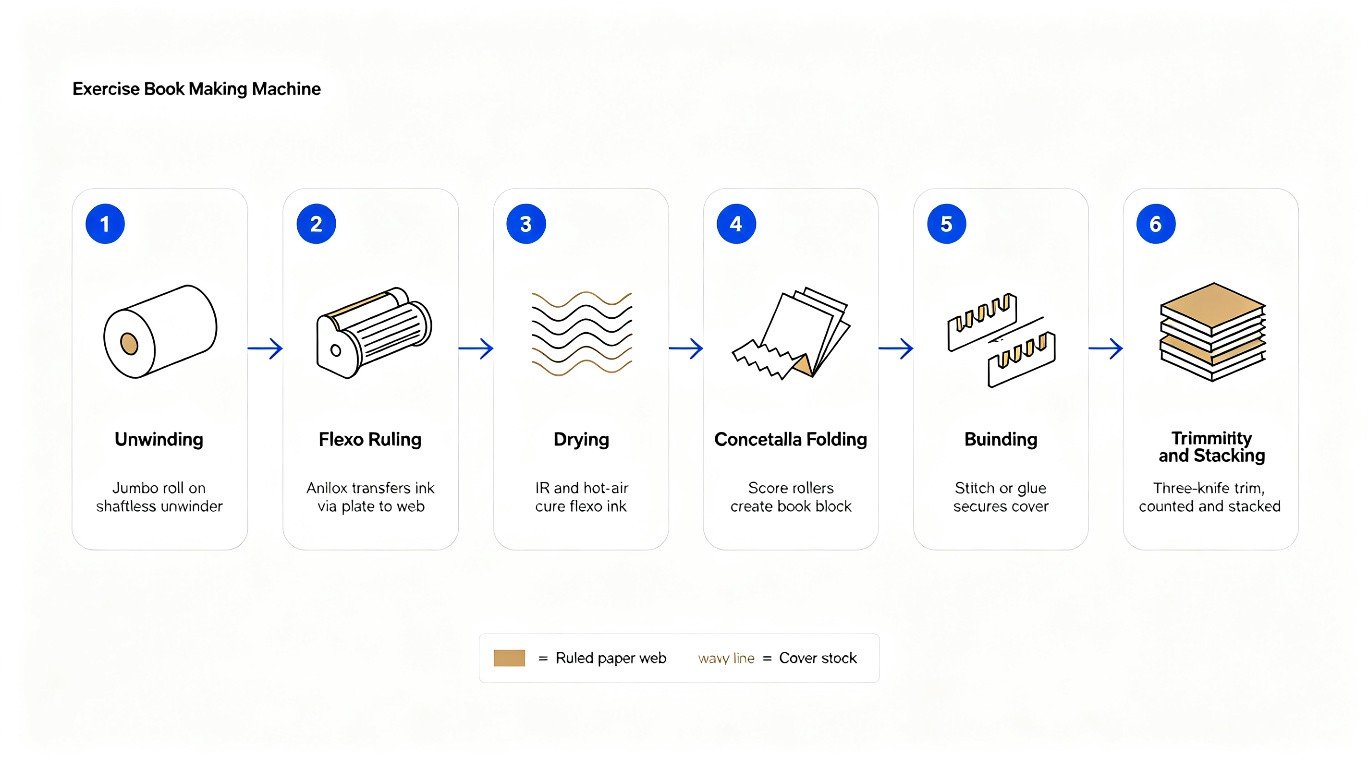
| Full automatic line | Unwinds → ruling → drying → folding → binding → three-knife trimming → stacking. Reel in, finished books out. | High-volume producers (500K+ books/order), government tender suppliers, in-house stationery manufacturers | 3–4 |
Monthly volume above 1 million books? A full automatic line is almost always the lower TCO option — labour savings justify the capital outlay within 12–18 months. Below that, a reel-to-bunch paired with a standalone binder provides better capital efficiency.
A key sub-decision for full automatic lines: double-sided ruling rules both sides before folding, halving web path length and improving fold accuracy — but adds 30–40% to machine cost. If all target products are under 40 pages, single-sided ruling is usually sufficient.
3 Select Your Binding Method
This decision — saddle stitching vs. perfect binding — is the most consequential technical choice in the selection process.
| Parámetro | Saddle Stitching | Perfect Binding |
|---|---|---|
| Method | Wire staples driven through the fold crest | Hot-melt EVA or PUR adhesive on milled spine |
| Page count range | 16–64 pages (8–32 sheets) | 40–200+ pages |
| Spine | Flat, staple-visible | Square spine — printable with title/branding |
| Lay-flat | Good — pages open fully | Poor to moderate |
| Durability | Good for moderate use; staples pull on thick blocks | Excellent with PUR; EVA weaker in hot climates |
| Consumables cost | Wire staples — negligible per unit | Hot-melt adhesive + spine tape — higher |
| Cycle speed | Up to 120 cycles/min | Moderate — glue application adds dwell time |
| Capital cost | Lower — simpler mechanics | Higher — glue pot, milling cutter, nipper station |
| Market positioning | Commodity school books, high-volume tenders | Premium notebooks, branded stationery, retail |
When to choose saddle stitching
Standard school exercise books — 20 to 60 pages, uncoated 55–65 gsm, government tender or mass-market. High cycle speed, near-zero consumable cost and excellent lay-flat make it the most cost-effective method for commodity books.
When to choose perfect binding
Premium notebooks, 80+ page products, or retail where presentation drives margin. Delivers a printable square spine and wider page-count flexibility.
Adhesive choice matters: EVA hot-melt is lower-cost but softens above 35°C — a concern in tropical markets. PUR adhesive costs more but provides superior bond strength and temperature resistance.
The combination-line option
A combination line with a swappable binding module lets you switch methods on the same platform. Capital premium: 25–35% over a single-method line — but eliminates two machines’ worth of floor space, labour and maintenance. At Heli Machinery, we build modular exercise book making lines with swappable binding stations because many clients in Africa and Latin America need to serve both segments from one facility.
4 Evaluate the Specifications That Actually Matter
Most quotation spec sheets are designed to look impressive rather than inform. Here is what to focus on — and which claims to treat with scepticism.
| Especificación | What to demand | Red flag |
|---|---|---|
| Maximum web speed | 80–150 m/min for production lines; >150 m/min for high-speed. Ask what speed is sustained at your target page count and paper grade. | Quoting max speed without stating test conditions — maximum speed and production speed are not the same thing. Actual throughput is typically 60–80% of rated maximum. |
| Anilox specification | Ceramic anilox, 120–250 lpi, supplied with at least two line-screen options to match different paper grades and ruling weights. | No anilox detail in the quote; a single anilox supplied for “all applications.” This suggests a one-size-fits-all approach that will compromise quality on at least some of your products. |
| Paper range | 45–100 gsm on a well-engineered line. Verify the tension system handles both extremes. | Narrow range (e.g., 60–80 gsm only) limits the markets and tenders you can supply. |
| Fold length accuracy | ±0.5 mm or better across the full speed range. | No accuracy tolerance specified — suggests the folder cannot hold tight tolerances at production speed. |
| Tamaño de refilado longitudinal | ±0.3 mm, clean cut with no tearing on minimum and maximum grammage. | Three-knife trimmer omitted from a “full automatic” line — you will need to budget for a separate trimmer or accept untrimmed books. |
| Changeover time | Ask for demonstrated changeover time between formats (e.g., A4 to A5) and page counts (e.g., 40-page to 80-page). | Manual changeover exceeding 60 minutes on a line marketed as “fully automatic.” True automation should allow format changes in 15–30 minutes. |
| Drive system | Servo-driven stations with PLC-based register control for consistent quality and fast makeready. | All-mechanical gear drive on a line priced above USD 60,000 — servo should be standard at that price point. |
| Control system | Branded PLC (Mitsubishi, Siemens) with HMI touch-screen. Fieldbus communication between stations. | Unspecified or unbranded PLC — proprietary or no-name controllers create spare-parts and service risk. |
Buyers often fixate on maximum speed and overlook makeready time — the time to thread the web, register the ruling, set the fold length and achieve trim accuracy after a roll change or format switch. A line that is 20% faster at maximum speed but takes twice as long to set up will produce fewer good books over a typical shift that includes 2–4 roll changes and 1–2 format changes. When evaluating demonstrations, time the makeready — not just the running speed. Contact us for a witnessed demo on your own paper grade.
5 Assess the Supplier, Not Just the Machine
A production line is a 10–15 year asset. The machine specification determines day-one capability; the supplier determines what happens on day 100, day 1,000 and day 3,000. Evaluate suppliers across five dimensions:
Manufacturing capability
Factory-direct or trading company? A manufacturer controls design, fabrication, assembly and testing — and can customise configurations without intermediaries. Ask for factory photos (not renderings), assembly videos and QC documentation. At Heli, our 12,000 m² facility in Lanxi City, Zhejiang Province handles the complete build cycle from CNC machining to final commissioning.
Component origins
Check which parts use recognised international brands. Key areas: PLC (Mitsubishi, Siemens, ABB), bearings (NSK, SKF), belts (HABASIT), electricals (Siemens, ABB, Schneider), servo motors (Mitsubishi, Yaskawa, Delta). This is not brand snobbery — it is about spare-parts availability. When a NSK bearing fails, you can source a replacement from any industrial supplier globally. A no-name component leaves you entirely dependent on the machine supplier.
Installation, training and after-sales
A proper package for a full line should include: on-site installation (15–25 working days), structured operator training with documented SOPs, and commissioning on your actual paper grade. Clarify whether engineer travel costs are included — they can add USD 3,000–8,000. For after-sales, ask: warranty terms, which wear parts are stocked for immediate dispatch, whether remote PLC diagnosis is available, and whether regional references exist.
Export track record
A supplier with machines in your target market understands local paper grades, electrical supply and logistics. Ask for specific country references. At Heli, our clients include APP Sinar Mas Group and Shanghai Chengfa domestically, and government-tender suppliers in Indonesia, Vietnam, Colombia, Mexico and Angola.[1]
6 Calculate Total Cost of Ownership
The purchase price is the most visible but least important number in the investment calculation. Total cost of ownership (TCO) over a 10-year production life typically breaks down as follows:
| Cost category | Typical TCO share | Notes |
|---|---|---|
| Machine purchase price | 25–35% | One-time; negotiate payment terms (typically 30% deposit, 70% before shipment or L/C at sight) |
| Raw materials (paper, covers, ink, staples/glue) | 55–65% | Recurring; paper alone is typically 55–65% of per-unit cost. Your procurement strategy matters more than machine price. |
| Energy | 2–4% | Recurring; verify total installed power (kW) and calculate against your local energy cost |
| Labour | 5–10% | Recurring; a full automatic line needs 3–4 operators/shift vs. 8–12 for semi-automatic setup |
| Maintenance and spare parts | 3–5% | Recurring; budget 1.5–2.5% of machine price annually after warranty period |
| Installation and training (amortised) | 2–4% | One-time; verify what is included vs. quoted separately |
Two TCO insights that surprise first-time buyers:
1. Waste reduction is where the machine earns its return. Paper is 55–65% of unit cost. A line running at 2–3% waste versus 5–8% waste on 50 tonnes/month saves 1.5–2.5 tonnes — a cost that recurs every month.
2. Uptime beats speed. A line at 80 m/min with 90% uptime out-produces one at 120 m/min with 70% uptime. Ask about MTBF on the installed base, not maximum speed.
Quick-Reference Selection Matrix
Use this matrix to identify your starting configuration before requesting quotations. Match your production profile to the recommended configuration, then use the specification checklist from Step 4 to evaluate supplier quotes.
| Your profile | Recommended line | Binding | Key spec priority |
|---|---|---|---|
| First-time buyer, <500K books/month, existing binder | Reel-to-bunch | Use existing | Anilox match to local paper, dancer-roll tension |
| Government tender, 1–5M books/month, 20–60 pages, standard ruling | Full automatic | Saddle stitching | Speed, uptime, staple-wire capacity, low waste |
| Retail premium, 500K–2M/month, 40–120 pages, branded covers | Full automatic | Perfect binding (PUR) | Spine quality, cover-feeding precision, glue-pot control |
| Mixed market (tender + retail), >2M/month, multi-format | Full automatic, combination | Swappable stitch/bind | Changeover time, servo drive, PLC register control |
| Flexible production, ruled sheets for multiple products | Reel-to-sheet | Separate downstream | Cross-cut accuracy, sheet stacking, format flexibility |
Frequently Asked Questions
Should I buy the cheapest machine that meets my minimum specs?
No. The cheapest option typically uses unbranded components and has limited after-sales support. Focus on TCO: a machine 30% more expensive that runs at 2% less waste and 15% higher uptime will cost less over its production life.
Can a single line handle both A4 and A5?
Yes. On servo-driven lines, format changeover takes 15–30 minutes. On mechanically-driven lines, 45–90 minutes. If you switch formats frequently, the servo-drive premium pays for itself in changeover savings alone.
Is a “fully automatic” line truly zero manual intervention?
No. Expect 3–4 operators per shift for roll loading, quality checks and fault response. The saving is versus semi-automatic production (8–12 operators), not versus zero labour.
What is the realistic payback period?
Full automatic line for government-tender volumes: typically 12–24 months. Reel-to-bunch added to existing capacity: 6–12 months. Faster where local paper is cheap and labour is expensive.
How do I verify a supplier’s claims?
Three steps: request a witnessed demonstration on your actual paper grade, contact client references in your region directly, and verify the supplier is a factory manufacturer (not a trading company) with evidence of in-house fabrication.
Key Takeaways
- Start with your production profile (page count, format, volume, paper grade) — never with price.
- Match line configuration to volume: reel-to-bunch below 500K/month, full automatic above 1M/month.
- Binding method is the most consequential decision: saddle stitch for commodity tenders, perfect binding for retail premium.
- Evaluate specifications on demonstrated performance, not rated maximums — makeready time and waste rate matter more than top speed.
- Assess the supplier’s track record and component brands; a machine is only as good as the team supporting it over 10+ years.
- Calculate TCO, not purchase price — paper waste reduction and uptime determine ROI, not sticker price.
Ready to Specify Your Exercise Book Line?
Send us your production profile — target product specs, monthly volume, paper grade and binding preference — and our engineers will configure a line that matches your requirements, with a detailed quotation, specification sheet and witnessed demonstration on your own substrates.
Request a Configured Quote